



Quick Hits
- Germany’s Federal Labor Court recently ruled that when a rejected applicant presents evidence suggesting she was denied employment solely because of her religious headscarf, the burden shifts to the employer to rebut that inference or face liability for damages.
- Employers seeking to enforce a company-wide headscarf ban must demonstrate an objective necessity. Vague “concerns about potential conflict” are insufficient.
- There is no state-mandated “neutrality requirement” applicable to personnel in the aviation security sector.
The Case: Application With Headscarf, Rejection Without Explanation
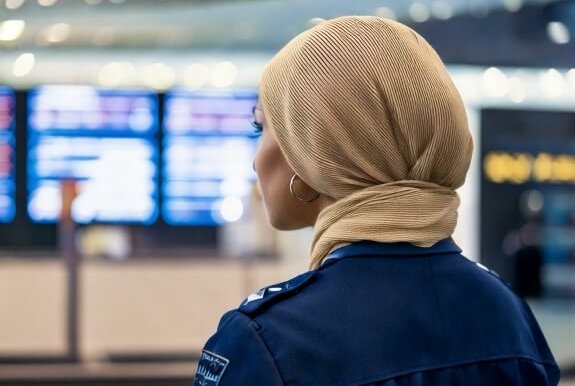
A Muslim woman applied for a position as an aviation security assistant at the passenger and baggage screening checkpoint at Hamburg Airport. Her application included a photograph showing her wearing a headscarf. She subsequently received a rejection letter. No reasons were provided.
Believing she had been discriminated against because of her Muslim faith, the applicant sought compensatory damages under the German General Equal Treatment Act (Allgemeines Gleichbehandlungsgesetz (AGG)). This statute broadly prohibits discrimination on the basis of national origin, sex, religion or belief, disability, age, or sexual orientation.
During the litigation that followed, the company, which had been contracted by the Federal Police to handle the hiring process, defended itself by citing an internal policy prohibiting head coverings and a purported “neutrality requirement.” The Labor Court (Arbeitsgericht) and the Regional Labor Court (Landesarbeitsgericht) of Hamburg ruled in favor of the applicant and awarded her compensatory damages.
The Decision: No Neutrality Requirement, No Justification
The BAG affirmed the lower courts’ decisions and denied the company’s appeal. Because no regulation in the aviation security sector generally prohibits the wearing of religious symbols while performing official duties, the company could not rely on a state-mandated neutrality requirement.
The court also rejected the argument that religious symbols could heighten tensions at security checkpoints, which are already inherently stressful environments with some potential for conflict. The company presented no concrete evidence that security personnel wearing headscarves had ever caused an increase in conflicts. A generalized concern that headscarves might lead to future conflicts amounts to mere speculation and is legally insufficient.
Key Takeaways
This decision underscores that employers may want to exercise heightened care during the hiring process to avoid discrimination. Under the AGG, even unconscious bias, such as a negative reaction to a headscarf visible in an application photograph, can trigger a statutory presumption of discrimination.
The BAG has now made clear that internal company policies alone cannot justify rejecting applicants who wear religious headscarves. Hiring decisions must be based on objective criteria rather than superficial appearances.
Ogletree Deakins’ Berlin and Munich offices and Aviation Industry Group will continue to monitor developments and will post updates on the Cross-Border and Germany blogs as additional information becomes available.
Lena Beyer LL.M.is an associate in the Berlin office of Ogletree Deakins.
Pauline von Stechow, a law clerk in the Berlin office of Ogletree Deakins, contributed to this article.
Image: Created by Adobe Firefly